A Jubilate Deo Interview with Chelsea Hamshaw, All Saints’, Florence
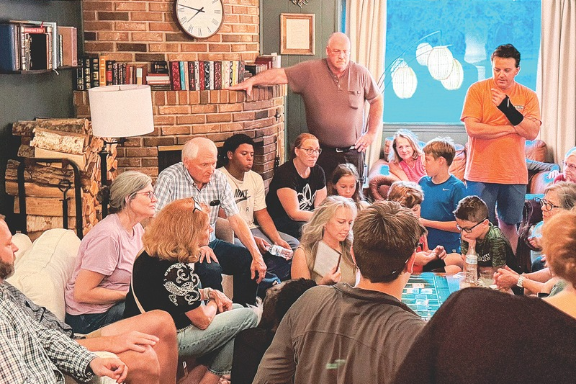
On July 15, Chelsea Hamshaw, who serves on staff at All Saints’, Florence (and is married to the rector, the Rev. Jason Hamshaw) and I chatted about the Game Nights she and Jason host in their home.
Jubilate Deo: Chelsea, how did you come up with the idea for a Game Night?
Chelsea Hamshaw: I’ve always loved the idea of having people into our home just to get to know them. And our family loves games. I was trying to figure out how we could have a lot of people over. And it just clicked. Games! Games are a much easier way to do that than saying, “Hey, 50 people from our church, why don’t you come over?”
Years ago, the diocese urged people to read The Gospel Comes with a House Key by Rosaria Butterfield. I loved the interplay between being the host and being hosted. There’s something about being in the home where I’m serving a meal that invites people to come alongside and help me get the mess together because my house is messy. I have seven people and a dog living in our house!
Jubilate Deo: So everything doesn’t have to be perfect?
Chelsea Hamshaw: There’s always a certain degree of chaos, but that’s part of what makes you feel at home. The book inspired me to think through how hospitality and life together in the church can look. Games provide a vehicle for people to get to know one another without the pressure of sitting down and trying to think of things to talk about.
Jubilate Deo: Do you play one game, or are people playing different games?
Chelsea Hamshaw: We have other games, but there’s one game in particular, Wits and Wagers, that allows everyone to join in. It’s a trivia game in which the answer to every question is a number. So, you might ask, “How many people could fit on the first Ferris wheel?” You get all kinds of wild guesses and then bet on the one you think is right. People get very into this game. We put people into random teams, so they don’t get to choose who’s on their team. That’s part of what helps people get to know each other.
Jubilate Deo: Do people outside the church come?
Chelsea Hamshaw: We have had visitors, friends of members, a few non-Christians or spouses of members who don’t come to church. But usually, it’s newer people who are visiting the church. It’s a great way for somebody to plug into the church quickly or for those on the periphery to experience community.
Jubilate Deo: Do the kids enjoy it?
(Chelsea’s son who’s sitting next to her chimes in) Ben: Yeah. I do!
Chelsea Hamshaw: Our kids love it, and the other kids do, too. Part of what’s been so special is you’ll have a 9-year-old battling it out on a team with a 70-year-old. They have a lot of fun and they get to know each other. Generations interact somewhat at church, but it’s stiff. In our home, they’re relaxed. Even the teenagers – who are notoriously socially awkward and often just shut down – join in the fun.
Jubilate Deo: About how many people will show up?
Chelsea Hamshaw: Usually, it’s between 30 and 50. One time we had about 60. That was a little crazy, and only about 30 played the game.
Jubilate Deo: What have you learned through this experience?
Chelsea Hamshaw: I certainly learned to let down my standards of what’s acceptable about the way my house looks. And I’ve learned how to cook for a lot of people. But I think the biggest thing I’ve learned is the value of generational blending. I don’t think it’s bad for young couples to have a group, or for retirees. There’s value in that, but I think the church has overemphasized splitting people into narrow age groups.
You often think it’s valuable for young people to hear the wisdom of older people. But I didn’t always see, until now, how valuable it is for older people to interact with children who aren’t their grandchildren. At game night, people of different ages make a special connection in a safe, fun way.
Jubilate Deo: What advice would you give to someone who wanted to do something similar?
Chelsea Hamshaw: I guess the biggest thing would be to let the chips fall where they may. There are certain elements you want to control, and that’s important, but let it take the form that fits your community.
We don’t put restrictions on toddlers coming because, yes, toddlers might interrupt the game, but the game isn’t the most important part. The most important part is people having the opportunity to gather together in a home and to feel the hospitality that the gospel automatically brings out in people.
Jubilate Deo: What would you say to naysayers who might diminish game night saying, “They should do a Bible study instead.”
Chelsea Hamshaw: I certainly wouldn’t diminish the value of Bible study, and Bible study is an important part of our church life and the Christian life. But to negate the daily in and out of Christian life together is to misunderstand the gospel and how we are meant to live together. The church is God’s vision from before the foundation of the world. It impacts every aspect of my life, every aspect of my home, every aspect where I gain joy, fellowship, and community. To delegate that to an organized once-a-week study is to diminish the way the gospel transforms lives.
We’ve had people hang around after game night sharing their struggles and deeper parts of their lives. Being in our home allows people to open up. It actually allows for gospel fruit to be born in conversation. And sometimes conversation without an agenda allows for deeper longevity in the fruit that’s born.
This article was originally published in the Fall 2026 edition of the Jubilate Deo, our Diocesan Newspaper. To subscribe to the newspaper and read other articles, visit https://adosc.org/news-events/jubilate-deo/