An Interview with The Rev. Canon Todd Simonis, ADOSC Canon for Church Planting
On May 4, 2026 I had an opportunity to chat with Todd Simonis about church planting and evangelism. Here’s an edited version of our conversation. Joy Hunter, Editor
The Scarcity Trap
Todd, why are so few of our churches planting churches?
I think for our diocese, the last several years have been spent navigating loss and fear and what might be taken from us. It’s hard to think generously if we have a mentality of scarcity.
As Anglicans, we have difficulty planting churches because we primarily think of “church” as a 90-minute, Sunday-morning expression. Trying to figure out how to replicate that somewhere else can be paralyzing. Where are we going to meet? What’s the rent going to cost? How are we going to have a choir? An organ? Silver and candles?
The first step toward planting a church is starting something new, start anything new.
The Church on Fripp was certainly something new. How did you start that?
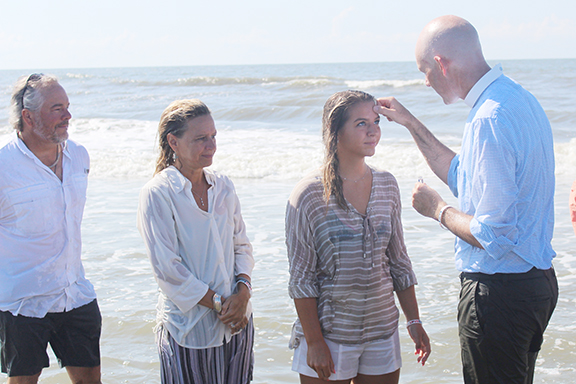
Actually, I didn’t start the Church on Fripp. Back in 2018, about 10 St. Helena’s members, who lived full time on Fripp, came and asked if we could do something evangelistic on the island. They pitched the idea of us doing some kind of beach service for about seven weeks. The plan was for it to be for the tourists, but what happened that first summer is many of the residents came to faith. Baptizing them caused a big stir. People were asking, “What’s going on?”
At the end of the seven weeks, the locals pulled me aside and said, “You can’t stop! We didn’t realize what we were missing. We need this to continue.”
So, rather than stopping, we paused, reorganized and continued meeting in October of 2018. By God’s Grace we have been meeting ever since.
We actually have two kinds of churches – the cold-weather one, which we hold in a small, all-faiths chapel. We can cram about 200 people in it, but we have overflow at this point in the off-season. Then, once the weather turns warm, we get out to the beach. That’s when it becomes much more evangelistic. We’ve never had a Sunday when we’ve been out setting things up that someone hasn’t walked up and said, “What are you doing?” It’s a profound joy.
Two weeks ago, there was a woman out walking on the beach. She’d had a miscarriage the previous week, and said, “I knew I needed to get away. Fripp was my happy place, so I’m here by myself.”
I said, “Well, I don’t believe in coincidences. Can we pray for you?” We all stopped setting up the sound equipment, gathered around and prayed for her.
That’s why we do what we do out in the open, because you never know who the Lord is going to send our way.
The Beach and the Witness Protection Program
I joke that in the summer months we’re the Church of the Witness Protection Program because everybody wears hats and sunglasses, and I don’t really know who’s there. But the numbers increase, especially in the summer. And we’ve seen a lot of healing.
So, you’re bringing the church to people – rather than the other way around.
In our culture, there’s a lot of skepticism about church and walking into a church building. We don’t have that. It’s safe in that if someone wants to leave, there are unlimited exit strategies. They just walk away. Some people drop by out of curiosity. Frankly, we have a congregation of people who are really filled with gratitude.
I think that some of that has to do with us not owning a building. We’ve never had to discuss carpet colors or replacing the roof. We get to be a fellowship of gratitude for what the Lord has done.
Not everyone has a beach to plant on, though. How does this translate elsewhere?
Church planting is just the natural extension of discipleship. If a church is truly discipling its people, individuals should be multiplying themselves.
Some churches have evangelism committees, but evangelism should be something all of us are doing. And I get why we have a
welcome team at church, but all of us should be welcoming.
One thing I ask, when I meet with a church interested in planting, is do they have anything else that has a mechanism for multiplication? Do they have small groups? If they say, “Oh, our small groups are great. The same 12 women have been meeting for 17 years,” I have to say, “Actually, that’s not a great thing.”
If we’re not teaching sacrificial multiplication along the way, it’s going to be really hard for a church to get behind church planting.
Sacrificial multiplication. It seems our churches are always teaching something, but we’re not strong on multiplication, on evangelism.
Evangelism is just discipleship to non-believers. As you’re talking with people who don’t yet know the good news, you’re discipling them closer to Christ, not in Christ.
Moving the Needle: The ENGEL Scale
There’s this evangelism scale we used to teach called the ENGEL scale. A -10 was somebody who’s never heard of Christ or they’re hostile to the gospel. And then a +10 is someone who is actively sharing their faith with others. We tend to focus on getting someone from a negative one to a positive one. Our culture loves that moment of decision. But it’s just as valid for the Lord to use you to take someone who’s a negative six to a negative five.
You are the Donut
So, the first step isn’t starting a church you can bring people to?
One of my most vivid memories is a conversation I had with my mentor. I was so frustrated that I could not get my best friend to go to church. I kept using church as the donut. I thought, “If I just get him to church and he hears the sermon, he’ll….” And my mentor said, “Todd, church is not the donut. You are the donut.” I didn’t like that; I wanted somebody else to do the work. If I just get them there, they’ll hear the sermon, listen to the music, and God will take care of it. But it doesn’t work that way.
We are the donut. Obviously, Jesus is – and the analogy breaks down here. But the goal isn’t to get somebody into a church building. The goal is for the church to engage with people where they are.
Jesus never once invited anybody to synagogue. Why do we not talk about that? We’ve got a lot of material on Jesus. He never said once, “Come with me to synagogue.”
Our problem is we want the church to do the work that’s actually been entrusted to us. You and I can uniquely reach different people where we are. And we’re called to disciple those we encounter where they are, to remember He’s with us wherever we go. So it’s Publix, it’s Lowe’s, it’s on a walk, it’s on the golf course, it’s when we’re cutting the lawn.
God isn’t asking each of us to start ministries, but he is calling every single one of us to be a minister to those around us.