
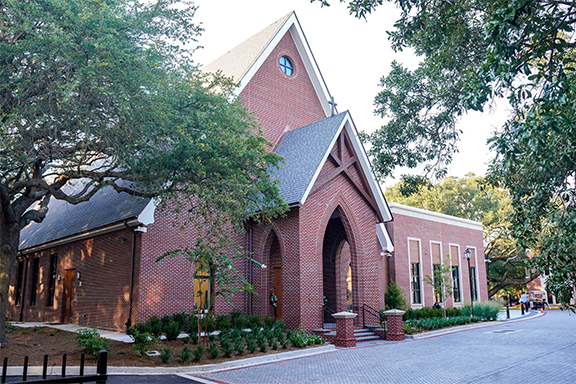
The following letter was sent to the clergy of the Anglican Diocese of South Carolina on August 25, 2026.
Dear Brother and Sister Clergy,
“This is the day that the Lord has made; we will rejoice and be glad in it!”
I write to apologize for the hurt feelings and re-opened wounds that the photographs of my participation in the dedication of the new St Timothy’s Chapel at Porter-Gaud School may have caused. I have heard from some—in our diocese, the Province, and even the wider communion—that the photographs of me and the Episcopal bishop have caused pain and confusion. I regret that very much.
Porter-Gaud School was established in 1867 by a priest from our diocese, Dr Anthony Toomer Porter. Since the school’s inception, the Bishop of our diocese has sat on the school’s board. When I was consecrated, I was asked to continue that tradition, and, being impressed by the gospel work I saw from our clergy and lay people who are there, I accepted.
When our diocese left the Episcopal Church, the board decided that to serve both ACNA and TEC constituencies they would have both bishops on the board. There is, of course, an inherent awkwardness in that arrangement.
We work and worship together at Porter-Gaud in a situation similar to what is sometimes called the Pax Nashotah, where many Anglican and Episcopal clergy, seminarians, and bishops worship together. Like Nashotah House, cooperation is limited to the needs of the work of the school, and is particular to that setting. For some, the online photos suggest things far beyond the limited scope of the school environment which are not true and cannot be ignored. We in the ACNA are in broken communion with TEC. Our disagreements are real and substantial. I know that. I’ve lived that. In no way do I intend to diminish that hard reality.
I intend to ask the College of Bishops to spend a season of prayer and reflection on these issues and provide guidance for how we interact with the Episcopal Church in these unique settings. As a bishop in the church, I will follow the College’s conclusion.
As a bishop and member of the board, I was asked to participate in the dedication of this new chapel. I worried that it could cause consternation. I also knew that my refusal to participate would be dispiriting to our diocesan clergy and lay people who serve there and the many diocesan families who send their children there. The gospel is bearing wonderful fruit at Porter-Gaud, and it is incumbent upon us to press into that work, not distance ourselves from it. I pray that, in spite of the trouble it has caused, my enthusiastic and joyful participation in this event served that good gospel work.
The liturgy was planned so that neither bishop would preach or celebrate the Eucharist. (The chaplain, one of our priests, preached and the gospel was clearly communicated.) In spite of good planning, such services inevitably involve difficult choices and produce awkward moments. The decision that both bishops would dedicate each piece of the furnishings seemed preferrable to dividing them up (who would get the Pulpit? The Table?). If I had consulted with my more experienced brother bishops, some of this confusion could have been avoided; that’s on me. As it is, I did my best to navigate this complex but important moment, knowing that it could have significant impact for gospel ministry at the school. Trying to navigate a challenging situation well, and do it with the joy and celebration that such a moment requires, doesn’t alleviate the confusion and pain that for some, especially in our parishes that lost so much. I’m sorry for that.
There is a photo of the two bishops at the Table. Before the service began, we were asked to help vest the newly consecrated Table. Some who saw these photos online understood them to show that we celebrated at the Table together. We did not.
Perhaps the greatest outcry has come from a photo of me with my Crozier and the Episcopal bishop with her hand on it. I wish I could go back and change that. Neither bishop was to carry a crozier in the service, as the Chapel is independent of both dioceses. At the last minute I was asked to use my Crozier only to mark the sign of the cross on the threshold of the door. After that, I put my Crozier away. It was not carried into the chapel nor was it used in any other part of the service. Clearly, both of our hands should not have been on it, even if only momentarily. In hindsight, I wish I had insisted on using the processional cross for that liturgical action and not my crozier. I understand how that image, too, suggests more than it was, and has become for some a source of anger and pain. I regret that.
Again, I tried to navigate that terrain carefully, but it is clear I made mistakes. Brothers and sisters, where my actions have offended, forgive me. At the same time, please pray for the good work that many in our diocese are engaged in at Porter-Gaud School.
Blessings,
+Chip